





Last updated on September 17th, 2026 at 02:24 pm
The IRS, state tax agencies, federal student loan agencies, and child support enforcement offices can garnish wages without first obtaining a court judgment. These entities use administrative authority rather than the traditional lawsuit process, although they are generally required to send statutory notices before withholding begins.
Private creditors, such as credit card companies or medical debt collectors, usually must sue you, properly serve you, and obtain a judgment before garnishing wages. If you were never served, whether the garnishment can be challenged depends on who is collecting the debt and whether required notices were issued.
Wage Garnishment Risk Assessment
Answer a few questions to estimate who may be collecting, whether notice was legally required, and what your next step should be.
This tool provides general information only and does not create an attorney-client relationship.
Your Results
Recommended Next Step
What This Tool Checks
- Whether the collector typically needs a court judgment
- Whether notice is generally required before wage withholding
- Whether “not served” could matter (private creditors)
- Whether fast action may reduce further withholding
Can Wages Be Garnished Without Notice?
Yes, wages can be garnished without a traditional court lawsuit in certain situations. But “without notice” does not always mean “without warning.” The real issue is whether a court case was required — and that depends on who is collecting the debt.
There are two completely different legal processes that can lead to wage garnishment.
When Can Wages Be Garnished Without a Court Case?
A court case is not required when the debt involves:
- IRS tax debt
- State tax debt
- Federal student loans
- Child support
These agencies have legal authority to issue wage levies administratively. That means they do not need to sue you or obtain a judgment first. However, they are generally required to send written notices before garnishment begins. The fact that no lawsuit occurred does not mean the garnishment was unlawful.
When Is a Court Judgment Required Before Garnishment?
A court judgment is usually required when the debt is owed to a private creditor, such as:
- Credit card companies
- Medical providers
- Personal loan lenders
- Collection agencies
In these cases, the creditor typically must:
- File a lawsuit
- Properly serve you
- Obtain a judgment
- Request a wage garnishment order
If those steps did not happen, the garnishment may be improper.
What If You Were Never Served With Court Papers?
Not being served matters most in private creditor cases.
If a lawsuit was filed but you were never properly served, you may have the right to challenge the judgment and potentially stop the garnishment. Courts do allow alternative service methods in some situations, so the details matter.
For IRS and other government garnishments, service of a lawsuit is not required at all. Instead, notices are typically mailed to your last known address. If they were sent correctly, the garnishment may still be valid even if you did not personally receive or open the mail.
The Legal Authorities Who Can Garnish Wages Without Notice
Different authorities have different powers. The rules depend on whether the garnishment is administrative or court ordered. Independent contractors should also understand garnishment rules for 1099 income, because levies on receivables and payments operate differently from ordinary payroll withholding.
The IRS
The IRS can garnish wages through a tax levy without first filing a lawsuit. This authority comes from federal tax law, not a court judgment.
Before garnishing wages, the IRS is generally required to:
- Assess the tax
- Send a Notice and Demand for Payment
- Issue a Final Notice of Intent to Levy
- Provide an opportunity to request a hearing
Once those steps are completed, the IRS can send a levy directly to your employer. Taking action before this final step is crucial for protecting what you own from collection.
Key distinction
The IRS does not need a judge’s approval, but it must follow federal notice procedures before enforcement begins.
State Tax Agencies
Most state tax departments have authority similar to the IRS. They can issue wage levies administratively without filing a lawsuit.
The process varies by state, but typically includes:
- Tax assessment
- Written demand for payment
- Notice of intent to levy
Unlike private creditors, state agencies rely on statutory enforcement powers rather than court judgments.
Key distinction: State procedures differ from federal rules, so deadlines and appeal rights depend on the state involved.
Federal Student Loans
When federal student loans go into default, the government can use Administrative Wage Garnishment.
This process allows wage withholding without a court order, but the borrower must first receive:
- Written notice of default
- Notice of intent to garnish
- An opportunity to request a hearing
The garnishment is capped at a percentage of disposable income under federal law.
Key distinction: Student loan garnishment has specific federal limits and hearing rights that differ from tax levies.
Child Support
Child support enforcement agencies can garnish wages based on court ordered support obligations. In many cases, wage withholding is automatic once a support order is entered. A separate lawsuit for garnishment is not required. Employers are typically required to comply immediately once served with an income withholding order.
Key distinction: Child support garnishment is tied to an existing support order, not a separate debt lawsuit.
Private Creditors
Private creditors usually cannot garnish wages without first going to court.
This means they must:
- File a lawsuit
- Properly serve the debtor
- Obtain a judgment
- Request a wage garnishment order
If service was improper or no judgment exists, the garnishment may be challengeable.
Key distinction: Private creditors rely on court enforcement, not administrative authority.
How Much Wages Can Be Garnished?
Federal law sets specific caps on how much of your paycheck can be garnished, but the limits depend on the type of debt and who is collecting it:
For most private debts (credit cards, personal loans, medical bills), federal law caps garnishment at the lesser of:
- 25% of your disposable earnings, or
- The amount by which your disposable earnings exceed 30 times the federal minimum wage (currently $217.50 per week).
This is defined under the Consumer Credit Protection Act (CCPA).
The IRS does not have a flat percentage cap like private creditors. Instead, the amount the IRS can take is based on IRS exemption tables that consider:
- Filing status
- Number of dependents
- Pay frequency
- Standard deduction and allowable living expense amounts.
In practical terms, this can mean the IRS may withhold a much larger share of your disposable income — essentially everything above your exempt amount — leaving very little take-home pay.
- Federal student loans: Administrative wage garnishment for defaulted federal student loans is capped at 15% of disposable earnings under federal law.
- Child support: Child support orders can require employers to withhold significantly more — often up to 50% of disposable income if you are supporting another spouse or child, or up to 60% if you are not supporting another spouse or child. An additional 5% may be allowed if support is more than 12 weeks past due.
These child support limits come from federal wage garnishment protections and often apply even if the support order was issued by a state court.
“Disposable earnings” is a legal term meaning your paycheck after legally required deductions, such as:
- Federal, state, and local income taxes
- Social Security and Medicare taxes
- State unemployment insurance tax
- Any legally required retirement contributions
Voluntary deductions — such as health insurance premiums, retirement contributions beyond required amounts, union dues, or charitable contributions — are not subtracted before calculating disposable earnings for garnishment purposes.
Bottom Line:
• Private creditors are generally capped at 25% of disposable earnings.
• Federal student loan garnishment is capped at 15%.
• Child support garnishment can reach 50–60% depending on your situation.
• IRS levies don’t have a fixed percentage cap and can often take most of your disposable income above exemptions.
How Does Wage Garnishment Work?
Wage garnishment follows a defined legal sequence. The exact steps depend on who is collecting the debt, but the process generally involves notice, employer involvement, and ongoing withholding until the debt is resolved.
Below is how it works in the most common scenarios.
Private Creditor Timeline
Private creditors must go through the court system before garnishing wages.
The typical sequence is:
- The creditor files a lawsuit for the unpaid debt.
- You are served with court papers.
- If you do not respond or lose the case, the court enters a judgment.
- The creditor requests a wage garnishment order from the court.
- The court sends the order to your employer.
- Your employer begins withholding part of your paycheck.
If you were never properly served, you may have grounds to challenge the judgment. Without a valid judgment, a private creditor generally cannot garnish wages.
IRS and State Tax Timeline
Tax agencies use administrative authority rather than filing a lawsuit.
The IRS process typically includes:
- Assessment of the tax debt.
- Notice and Demand for Payment.
- A Final Notice of Intent to Levy.
- A 30-day period to request a hearing.
- If no resolution occurs, the IRS sends a wage levy to your employer.
State tax agencies follow similar procedures, though deadlines and notice requirements vary by state.
Student Loan and Child Support Timeline
Federal student loans and child support use administrative withholding.
For federal student loans:
- The loan enters default.
- You receive written notice of intent to garnish.
- You are given an opportunity to request a hearing.
- If no resolution occurs, the garnishment order is sent to your employer.
For child support:
- A court issues a support order.
- Income withholding is often automatic.
- The employer must begin withholding once served with the order.
In child support cases, garnishment may begin quickly because it is tied to an existing court order.
How Long Garnishment Can Last
Wage garnishment typically continues until one of the following happens:
- The debt is paid in full
- A settlement is reached
- A payment plan replaces the garnishment
- A court vacates the judgment
- The agency releases the levy
- Bankruptcy triggers an automatic stay
For private creditor judgments, garnishment may continue until the judgment amount plus interest is satisfied. Some judgments can remain enforceable for years and may be renewable.
For IRS levies, withholding continues until the debt is resolved, the levy is released, or collection status changes.
In student loan and child support cases, garnishment can continue long term if the balance remains unpaid.
Your Employer’s Requirements
Once a wage garnishment order or levy is issued, your employer becomes legally obligated to comply. In most cases, the employer is not deciding whether the garnishment is valid. They are responding to a legal directive.
The employer’s role is administrative, not judicial. Their responsibility is to calculate the required withholding and remit the funds as instructed.
When an employer receives a garnishment order or levy, they are typically required to:
- Verify the employee’s identity
• Calculate disposable earnings
• Apply the legally permitted withholding amount
• Begin deductions by the deadline stated in the order
• Send withheld funds to the court or agency
For private creditor garnishments, the employer receives a court order. For IRS or state tax levies, the employer receives a levy notice directly from the agency.
Employers generally have no legal authority to reject or disregard a valid garnishment order.
If they fail to comply, they may:
- Become legally liable for the amount that should have been withheld
- Face penalties or fines
- Be held in contempt of court (in court-based cases)
Because of this risk, most employers comply immediately once served with a valid order. Even if you tell your employer the garnishment is unfair or incorrect, they usually must continue withholding until the court or agency formally releases the order.
Errors can happen, but they typically fall into two categories:
- Withholding too much
- Failing to follow exemption limits
If an employer withholds more than the law allows, the issue may need to be corrected through the court or agency that issued the order. Employers are expected to follow federal and state garnishment caps, including limits on disposable earnings. If an employer fails to withhold when required, they may be held financially responsible for the missed amounts.
Importantly, your employer is not responsible for resolving the underlying debt dispute. Challenges must be directed to the creditor, court, or agency that issued the garnishment
What Rights Do You Have if Wage Garnishment Starts Without Notice
If wage garnishment begins and you believe you were never notified, you may still have legal rights. The available options depend on who issued the garnishment and whether required procedures were followed.
The key questions are:
- Was a court judgment required?
- Were required notices sent?
- Were you properly served, if service was required?
- Are appeal or hearing deadlines still open?
Your rights differ depending on the type of debt.
If the IRS Is Garnishing Your Wages
The IRS does not need a court judgment to garnish wages, but it must follow federal notice procedures before issuing a levy.
Generally, the IRS must:
- Assess the tax
- Send a Notice and Demand for Payment
- Issue a Final Notice of Intent to Levy
- Provide at least 30 days to request a Collection Due Process hearing
IRS LEVY NOTICE OPTIONS
If You Did Not Receive Required Notices, You May Still Have Options
Depending on timing and your situation, you may still be able to take one or more of the actions below.
Request a Collection Due Process hearing
Applies if you are still within the required deadline window.
Request an Equivalent Hearing
May be available if the 30-day window has passed.
Apply for hardship relief
If the levy is preventing you from meeting basic living expenses.
Seek levy release due to financial hardship
In some situations, the IRS may release the levy to prevent undue hardship.
Enter an installment agreement or other resolution
A formal payment plan or alternative resolution may stop or reduce collection pressure.
Deadlines can apply. The best option depends on your notice history and current status. Securing professional help when you owe the IRS can make a significant difference in determining which of these relief options is best suited for your specific financial situation.
If a Private Creditor Is Garnishing Your Wages
Private creditors generally must obtain a court judgment before garnishing wages.
If you were never served with the lawsuit, you may have the right to:
- File a motion to vacate the judgment
• Challenge improper service
• Request the court review the garnishment
If the court finds service was improper, the judgment may be set aside and the garnishment could stop. However, strict deadlines often apply. Waiting too long can limit your options.
If You Were Not Served
Being “not served” matters most in court-based garnishments.
Proper service means legal delivery of lawsuit documents under state rules. If service was defective — for example, served at the wrong address or not delivered according to law — you may have grounds to challenge the judgment.
However, courts sometimes allow substitute service, such as:
- Service at a last known address
- Service on another adult in the household
- Service by publication in limited cases
The question is not whether you personally saw the paperwork, but whether legal service requirements were met.
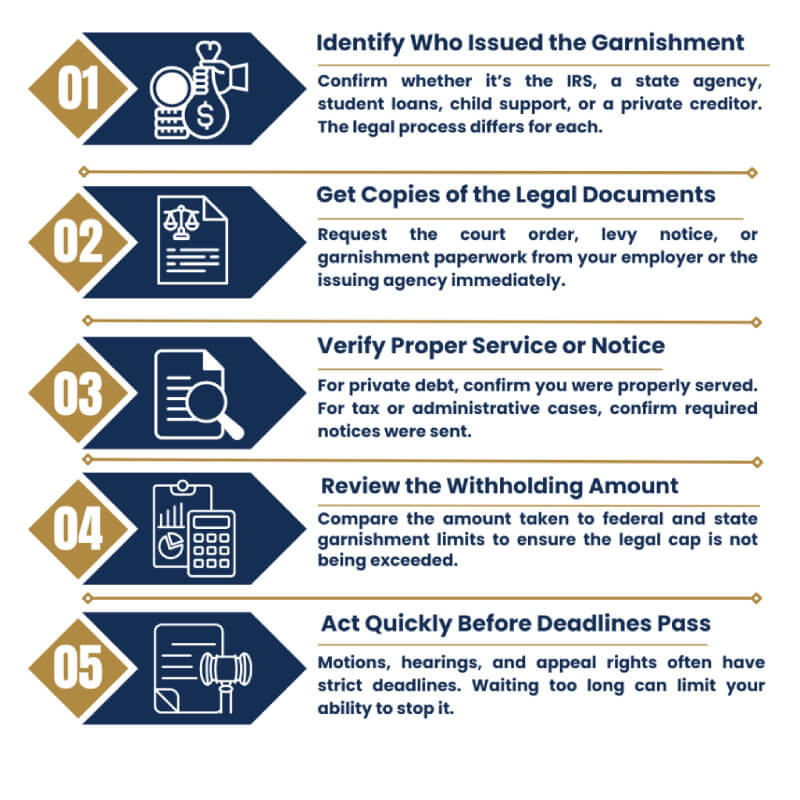
Steps You Should Take if You Believe Wage Garnishment Happened Unlawfully
Conclusion
Wage garnishment without notice is not always unlawful, but whether it can be challenged depends entirely on who is collecting the debt and whether required legal procedures were followed. Government agencies such as the IRS and state tax authorities can garnish wages without a court judgment, while private creditors generally must obtain one first. If you believe your wages were garnished improperly, the most important steps are to identify the issuing authority, confirm whether notice or service requirements were met, and act quickly before deadlines expire. Taking prompt action can preserve your rights and may allow you to stop, reduce, or challenge the garnishment before further income is withheld.
Frequently Asked Questions
Can my bank account be garnished without notice?
Yes, a bank account can be garnished without advance personal notice in some cases. Private creditors must usually obtain a court judgment first, but once a bank levy is issued, funds may be frozen before you are informed. The IRS and state tax agencies can also issue bank levies after required statutory notices have been sent.
How to check wage garnishment balance?
To check your wage garnishment balance, review the original court judgment or levy notice and contact the issuing court or agency directly. Your employer can tell you how much has been withheld, but only the creditor or agency can confirm the remaining balance. For IRS garnishments, you can request an account transcript.
How can I apply for garnishment hardship?
If the IRS is garnishing wages, you may request hardship relief by showing that the levy prevents you from paying basic living expenses. This often involves submitting financial information to support a levy release or collection alternative. For private creditors, hardship requests are typically made through the court. If IRS collection has reached your paycheck, garnishment release through counsel may require prompt review of the levy notice, hardship evidence, and available resolution options.
How to find out who is garnishing your wages?
Ask your employer for a copy of the garnishment order or levy notice. The document will identify whether the garnishment is from a court judgment, the IRS, a state tax agency, student loans, or child support enforcement. You can also check local court records if it appears to be a private creditor.
Can the IRS garnish wages without warning?
The IRS does not need a court judgment to garnish wages, but it must generally send required written notices before issuing a levy. This includes a Final Notice of Intent to Levy and a 30-day opportunity to request a hearing. If those notices were properly sent, the levy can proceed.
Can they garnish wages for medical bills?
Yes, medical bills can lead to wage garnishment, but only after the creditor files a lawsuit and obtains a court judgment. Proper service of the lawsuit is required before a garnishment order can be issued. Without a valid judgment, wage garnishment is typically improper.
What if my employer did not notify me of wage garnishment?
Employers are generally required to comply with a valid garnishment order but are not always required to provide advance personal notice before withholding begins. Notice usually comes from the court or agency issuing the order. You should request a copy of the garnishment documents immediately.
How can I stop a wage garnishment immediately?
Stopping a wage garnishment immediately depends on who issued it. You may be able to file a motion to vacate a judgment, request a hearing, negotiate a payment plan, or seek hardship relief. Fast action is critical because strict deadlines often apply.