






Last updated on September 16th, 2026 at 02:29 pm
Wage garnishment can be stopped by paying the debt in full, negotiating a settlement or payment plan, filing a claim of exemption, requesting a court hearing, proving financial hardship, or filing for bankruptcy. If the garnishment has already started, you may be able to have it released by negotiating with the creditor, challenging the order in court, or seeking legal protection through bankruptcy.
What Is Wage Garnishment?
Wage garnishment is a legal process that allows a creditor to take money directly from your paycheck to satisfy a debt. Instead of collecting from you personally, the creditor obtains a court order or government authorization requiring your employer to withhold a portion of your wages and send it to them.
Wage garnishment can apply to different types of debts, including:
- Credit card balances
- Medical bills
- Personal loans
- Tax debts: The discussion of when your refund can be garnished explains when a federal or state refund may be offset and what notice or challenge procedures may apply.
- Child support and alimony
- Federal student loans
The IRS is Forgiving Millions Each Day. You Could Be Next.
How Much of Your Wages Can Be Garnished?
Under federal law, most creditors can garnish the lesser of:
- 25% of your disposable earnings, or
- The amount by which your weekly disposable earnings exceed 30 times the federal minimum wage
Disposable earnings are your wages after legally required deductions such as federal and state taxes, Social Security, and Medicare.
For example, if your disposable income is $800 per week, a creditor may be able to garnish up to $200, depending on the calculation. However, different rules apply depending on the type of debt:
- Child support and alimony: Up to 50 to 65% of disposable earnings may be garnished, depending on whether you support another spouse or child and whether payments are overdue.
- Federal student loans: The government can administratively garnish up to 15% of disposable pay without a court order.
- Tax debts: The IRS does not follow the 25% rule. Instead, it calculates an exempt amount based on your filing status and number of dependents, and may garnish the rest.
State laws may provide additional protections that limit how much can be taken. In some states, lower caps apply, or certain income may be fully protected. Because the percentage and rules vary by debt type and jurisdiction, reviewing the specific garnishment order is essential to determine whether the amount being withheld is legally correct. An experienced wage garnishment attorney can review the order, calculate whether the correct amount is being taken, and identify any legal errors or exemptions that may reduce or stop the garnishment.
The Legal Notices You Must Receive Before Wage Garnishment
Before wages can be garnished, creditors and government agencies must send formal written notices giving you an opportunity to respond. The type of notice depends on the debt involved.
For credit cards, medical bills, personal loans, and other private debts, the process typically includes:
- Summons and Complaint – Notifies you that a lawsuit has been filed
- Court Judgment – Issued if you lose the case or fail to respond
- Writ of Garnishment or Garnishment Order – Directs your employer to withhold wages
If you fail to respond to the lawsuit, the court may enter a default judgment, allowing the creditor to proceed with garnishment.
The IRS does not need a court judgment before garnishing wages, but it must send specific notices, including:
- Notice and Demand for Payment
- Final Notice of Intent to Levy and Notice of Your Right to a Hearing (often Letter 1058 or LT11)
You generally have 30 days from the Final Notice to request a Collection Due Process hearing before the levy begins.
For defaulted federal student loans, the government may use administrative wage garnishment. Required notices typically include:
- Notice of Intent to Garnish Wages
- Explanation of your right to request a hearing
You usually have 30 days to request a hearing before garnishment begins.
How to Stop Wage Garnishment?
If you have received notice of a lawsuit, judgment, or intent to garnish your wages, time matters. In many cases, wage garnishment can be stopped — but the strategy depends on the type of debt, the stage of enforcement, and whether your employer has already begun withholding money. Below are the primary steps that may help stop wage garnishment before it escalates further.
1. Pay the Debt in Full
Paying the full balance owed before a garnishment order is enforced is the most direct way to stop the process. Once the debt is satisfied, the creditor must cease collection activity and cannot proceed with wage withholding.
If garnishment has already begun, full payment generally requires the creditor to issue a release of garnishment so your employer can stop deductions. While full payment is not always financially feasible, it remains the fastest way to resolve the issue when available. Acting before the garnishment order is processed by your employer may prevent any interruption to your paycheck.
2. Negotiate a Settlement
If full payment is not realistic, negotiating a structured resolution may prevent wage garnishment from starting or may result in the release of an active garnishment. The type of settlement available depends on the debt involved, the balance owed, and your financial condition.
Installment Agreement or Payment Plan
An installment agreement allows you to repay the debt over time through structured monthly payments. For private creditors, entering into a formal payment plan before a garnishment order is finalized may prevent enforcement from moving forward.
For tax debts, the IRS and most state agencies offer approved installment agreements. Once properly established, these agreements may prevent a wage levy from being issued. In certain situations, an existing levy may be released after compliance is confirmed and required payments are made. In addition to resolving wage garnishments, setting up a formal repayment structure is an effective strategy for protecting your accounts from a levy before the IRS takes further action. Establishing this compliance early serves as a proactive defense against property seizure should the agency attempt to claim physical assets to satisfy your tax debt.
Offer in Compromise (OIC)
An Offer in Compromise allows qualifying taxpayers to settle tax debt for less than the full amount owed. Approval is based on financial analysis, including income, expenses, equity in assets, and future earning potential.
While an offer is under review, collection activity may be suspended in qualifying situations. If accepted, the remaining balance is resolved, and enforcement actions such as wage levy are terminated.
Offers in Compromise are document-intensive and require accurate financial disclosure. Submission without proper preparation can result in rejection and continued enforcement.
When Settlement Makes Sense
Negotiation may be appropriate when:
- The debt is valid but immediate full payment is not possible
- You want to avoid public court enforcement
- You are still within the notice period
- You can demonstrate consistent payment ability
Structured negotiation is not simply asking for more time. It requires strategic presentation of financial information and understanding of the creditor’s enforcement posture.
3. Request a Hearing or File an Appeal
If you believe the garnishment is incorrect or improperly issued, you may have the right to challenge it. Acting within the required deadline is critical. Once the notice period expires, your ability to stop enforcement becomes more limited. The type of hearing available depends on the creditor involved.
For credit cards, medical bills, personal loans, and other private debts, garnishment generally follows a court judgment. If errors occurred in that process, you may be able to request a court hearing.
Common grounds for challenge include:
- You were never properly served with the lawsuit
- A default judgment was entered without valid notice
- The amount being garnished exceeds legal limits
- The debt has already been paid or resolved
- Identity errors or incorrect balances
Filing a motion with the court may temporarily pause enforcement while the issue is reviewed. If the court finds procedural defects, the garnishment may be reduced or vacated.
For IRS wage levies, the most important protection is the 30-day window after receiving the Final Notice of Intent to Levy (Letter 1058 or LT11). For continued enforcement risk, review how repeat levies work, including why the IRS may issue additional levies while an unpaid balance remains unresolved.
Within that period, you may request a Collection Due Process (CDP) hearing. A timely CDP request can suspend levy enforcement while your case is under review. During the hearing, you may challenge the proposed levy, raise procedural defects, propose an installment agreement, submit an Offer in Compromise, request hardship relief
If the 30-day deadline has passed, alternative appeal options may still exist, but collection activity may continue during review.
Pro Tip: Hearing rights are powerful but time sensitive. They do not automatically eliminate the underlying debt, but when exercised within the required deadline, they can delay or stop wage garnishment before enforcement escalates
4. File a Claim of Exemption
A claim of exemption is used when the law limits how much of your wages can be taken. It is a formal request asking the court or agency to reduce or stop garnishment because the amount being withheld exceeds legal limits. This remedy is based on statutory protections — not negotiation and not financial hardship.
Under federal law, most private creditors may garnish only the lesser of:
- 25% of your disposable earnings, or
- The amount by which your weekly disposable income exceeds 30 times the federal minimum wage
Disposable earnings are calculated after legally required deductions such as federal and state taxes, Social Security, and Medicare. If more than the allowable amount is being withheld, you may have grounds to file an exemption.
Many states provide stronger wage protections than federal law. Some states:
- Cap garnishment below 25%
- Protect a higher portion of low-income wages
- Provide additional protections for heads of household
If state law offers greater protection, it generally controls the allowable withholding amount.
Garnishment orders are not always calculated correctly. Common errors include:
- Miscalculating disposable income
- Failing to apply state-specific limits
- Garnishing protected income
- Applying the wrong percentage cap
A claim of exemption allows you to formally challenge these issues.
5. Request Hardship Relief
Even when a garnishment is legally valid, relief may still be available if the wage deductions create serious financial strain. Hardship relief focuses on your ability to meet necessary living expenses, not on whether the garnishment exceeds statutory limits.
If wage withholding prevents you from covering basic costs, you may be able to request a reduction, suspension, or temporary halt of the garnishment.
Hardship relief may be appropriate if garnishment leaves you unable to afford:
- Rent or mortgage payments
- Utilities
- Food and household essentials
- Transportation to work
- Necessary medical expenses
- Support for dependents
Courts and agencies typically require documentation showing your income, monthly expenses, assets, and financial obligations.
For federal tax debts, taxpayers who cannot afford to make payments without severe financial difficulty may qualify for Currently Not Collectible (CNC) status. If approved, CNC status can suspend active collection efforts, including wage levy. The IRS will review your financial information to determine whether paying the tax debt would prevent you from meeting basic living standards.
While CNC does not eliminate the debt, it may provide temporary relief from enforcement while your financial situation stabilizes.
To request hardship relief, you must submit detailed financial information, often including:
- Income statements
- Monthly expense breakdown
- Bank account information
- Asset disclosures
Approval is based on documented financial need. Incomplete or inaccurate disclosures can delay or weaken the request. Because hardship determinations involve financial analysis and agency discretion, careful preparation is critical.
7. Consider Bankruptcy Protection
If other efforts to stop wage garnishment have failed, bankruptcy may provide immediate and broader relief. When a bankruptcy petition is filed, a federal court order known as the automatic stay takes effect. This order prohibits most creditors from continuing collection activity, including wage garnishment.
In many cases, garnishment stops shortly after the bankruptcy filing is processed and notice is provided to the creditor. However, the long-term outcome depends on the type of bankruptcy filed.
Chapter 7 bankruptcy is designed to eliminate qualifying unsecured debts, such as credit cards, medical bills, and personal loans. Once the case is filed, the automatic stay prevents further wage withholding related to those debts. If the debt is dischargeable, the creditor permanently loses the legal right to continue collection after the bankruptcy is completed. This can provide a clean break from ongoing garnishment for eligible unsecured obligations.
Chapter 7 is typically considered when income is limited and the majority of the debt is unsecured. Eligibility is determined through a financial review known as the means test.
However, not all debts are eliminated under Chapter 7. Certain tax obligations, child support, and most student loans may remain enforceable depending on the circumstances.
Chapter 13 bankruptcy operates differently. Instead of eliminating debt immediately, it creates a structured repayment plan lasting three to five years.
After filing, the automatic stay stops wage garnishment. Past-due amounts may be consolidated into the repayment plan, allowing you to make manageable monthly payments under court supervision.
Chapter 13 may be appropriate if you have regular income and need time to repay tax debts, mortgage arrears, or other secured obligations. It is also commonly used when a taxpayer does not qualify for Chapter 7. Unlike Chapter 7, Chapter 13 focuses on financial reorganization rather than liquidation.
Pro Tip: bankruptcy carries long-term financial and credit consequences, it should be evaluated carefully and typically considered after reviewing less disruptive options.
8. Seek Legal Assistance
Wage garnishment is a forced enforcement action. Once it begins, a portion of your income is taken automatically — often with little room for error and limited time to respond. Stopping it requires a structured legal strategy tailored to the type of debt and stage of enforcement.
At J. David Tax Law, our attorneys evaluate:
- The validity of the garnishment notice
- Applicable appeal deadlines
- Statutory wage limits
- Eligibility for settlement or payment programs
- Financial hardship qualification
- Procedural errors that may support immediate relief
In qualifying cases, our team has secured garnishment releases in as little as 48 hours. Nationwide, we have helped clients resolve more than $800 million in tax liabilities through formal legal negotiation and structured resolution programs.
Preventing Wage Garnishment in the Future
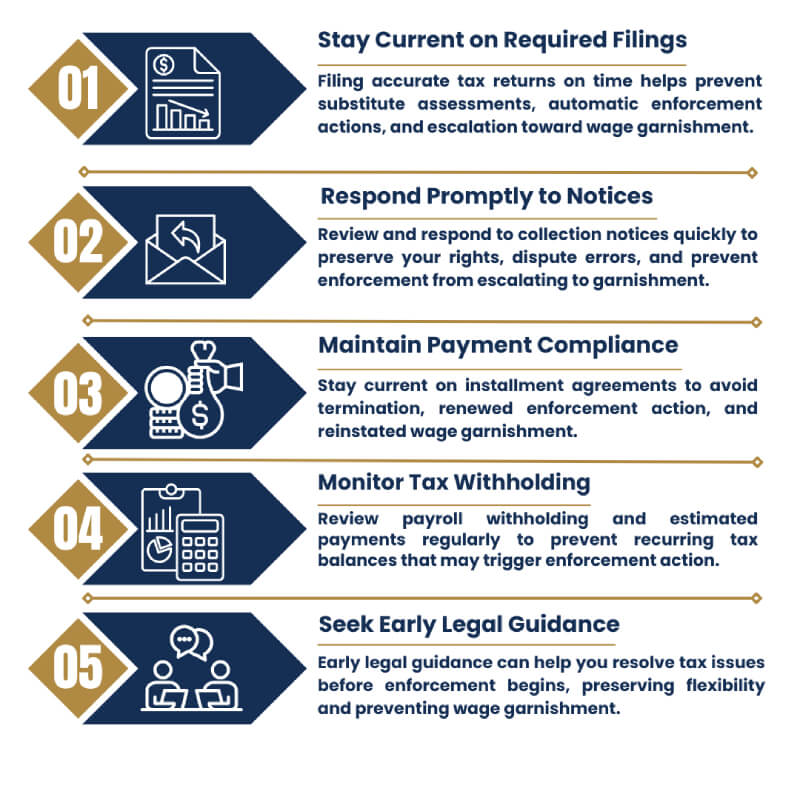
Once a wage garnishment is resolved, preventing future enforcement should become a priority. Garnishment typically follows missed payments, ignored notices, or unresolved tax liabilities. Addressing issues early can significantly reduce the risk of repeated collection action. Below are practical steps that may help prevent wage garnishment from recurring.
Conclusion
Wage garnishment can often be stopped immediately, but the available solution depends on the type of debt and how far enforcement has progressed. Options may include negotiating a settlement, requesting a hearing, filing a claim of exemption, proving financial hardship, or seeking bankruptcy protection. The most effective step is acting quickly during the notice period or as soon as wages begin to be withheld. Because deadlines are strict and each case is fact-specific, reviewing your situation promptly can help determine the fastest and most appropriate way to stop the garnishment and protect your income.
Frequently Asked Questions
How can I apply for garnishment hardship?
You can apply for garnishment hardship by submitting a financial hardship request to the court or agency handling the garnishment, along with proof of income and living expenses. If approved, the garnishment may be reduced or temporarily suspended.
Can you stop a garnishment after it starts?
Yes, a garnishment can sometimes be stopped after it starts by negotiating a payment plan, filing an exemption claim, requesting hardship relief, or filing for bankruptcy. The available option depends on the type of debt and enforcement stage.
How to stop wage garnishment for student loans?
To stop federal student loan garnishment, request a hearing within 30 days of the notice or enter into loan rehabilitation or consolidation. Acting quickly may prevent or reduce ongoing wage withholding.
How to stop wage garnishment for a car loan?
To stop wage garnishment for a car loan, you must resolve the court judgment through settlement, payment plan, exemption, or bankruptcy. Garnishment typically follows a deficiency balance after repossession.
Can you set up a payment plan after garnishment?
Yes, you can set up a payment plan after garnishment begins, and the creditor may agree to release the garnishment once payments are approved. Early negotiation improves the likelihood of release.
What is a motion to dismiss garnishment?
A motion to dismiss garnishment is a court request asking a judge to stop wage withholding due to legal or procedural errors. It may be filed if notice was improper, the amount is incorrect, or the debt is invalid.
What’s the best way to stop a garnishment?
The best way to stop a garnishment depends on the debt type, but common solutions include paying the balance, negotiating a settlement, claiming an exemption, requesting hardship relief, or filing bankruptcy.
How do I write a letter to stop wage garnishment?
To write a letter to stop wage garnishment, clearly state the reason you are requesting relief, provide supporting documentation, and request review or suspension of enforcement. A formal hardship or dispute request may require specific forms.