






Last updated on September 14th, 2026 at 04:47 pm
A state tax lien is a legal claim filed by a state tax authority against your property when you fail to pay a state tax debt.
It does not mean your assets are immediately seized, but it gives the state a secured interest in your real estate, bank accounts, and other assets until the tax liability is resolved. A separate analysis of tax debt in bankruptcy explains why dischargeability depends on the tax type, return-filing history, assessment date, and other requirements.
At J. David Tax Law, we regularly help taxpayers resolve state tax liens before they escalate into wage garnishments, bank levies, or asset seizures. The earlier a lien is addressed, the more options are typically available to remove or reduce its impact.
Recent Federal and State Tax Lien Enforcement Updates
Tax enforcement activity has increased in 2026, and both federal and state agencies are moving more quickly in filing liens and initiating collection actions.
- Expanded IRS Automated Enforcement
The IRS continues to expand automated collection systems, accelerating the filing of federal tax liens, levies, and wage garnishments for unpaid balances. - Faster Notice Processing
Many taxpayers are receiving Notices of Federal Tax Lien and Final Notices of Intent to Levy sooner than in prior years due to modernization of IRS systems. - State-Level Collection Acceleration
Several states have strengthened enforcement procedures, including quicker lien recordings and expanded collection authority.
State Tax Lien Definition Explained
A state tax lien is the government’s legal claim against your property after a state tax debt has been assessed and remains unpaid. It arises by operation of law once the state issues a formal tax assessment and you fail to satisfy the balance within the required timeframe.
Unlike a levy, which involves the actual seizure of assets, a lien secures the state’s interest in your property. It attaches to assets you currently own — such as your home, business property, vehicles, and financial accounts — and can also attach to future property acquired while the lien remains in effect. If you have an underlying debt with penalties and interest added up, it’s time to settle it. Before you contact the state or the IRS to resolve a lien, you should run a two-minute penalty estimate to confirm the actual payoff amount, which is often higher than the balance shown on the original notice.
In most states, once the lien is recorded with the county clerk or secretary of state, it becomes a matter of public record. This can:
- Interfere with refinancing or selling property
- Prevent clear title transfers
- Complicate business financing
- Damage personal and commercial credit
Difference Between a State Tax Lien and a Federal Tax Lien
A state tax lien is filed by a state tax agency for unpaid state taxes, while a federal tax lien is filed by the Internal Revenue Service for unpaid federal taxes. Both create a legal claim against your property, but they are governed by different laws, procedures, and enforcement timelines.
Although the concept is similar, the authority behind the lien matters significantly when it comes to how it is recorded, how long it lasts, and how it can be resolved.
| State Tax Lien | Federal Tax Lien |
|---|---|
| Filed by a state department of revenue or taxation agency. | Filed by the Internal Revenue Service. |
| Applies to unpaid state taxes (income, sales, payroll, franchise, etc.). | Applies to unpaid federal taxes (income, payroll, corporate, etc.). |
| Governed by state statutes and state-specific procedures. | Governed by federal tax law and IRS procedures. |
| Recorded according to the state’s filing system (often county records or a state registry). | Recorded as a Notice of Federal Tax Lien in county or state records. |
| Duration depends on state statute of limitations and renewal rules. | Generally lasts for the IRS collection statute (often 10 years from assessment unless extended). |
| Resolution options depend on state-specific rules (release, withdrawal, settlement, appeals). | Resolution options follow IRS programs (release, withdrawal in limited cases, appeals). |
| Can exist at the same time as a federal lien, creating priority conflicts. | Can exist at the same time as a state lien, creating priority conflicts. |
State Tax Lien vs Tax Levy — Key Differences
A state tax lien and a tax levy are related enforcement tools, but they serve very different purposes. A lien establishes the government’s legal claim against your property. A levy is the action that allows the government to collect by seizing assets. Understanding the distinction is critical because the legal strategy for resolving each is not the same.
A state tax lien is a legal claim against your property for unpaid taxes. It secures the state’s interest but does not immediately take your assets.
A tax levy, on the other hand, authorizes the state to seize property or funds to satisfy the debt. This can include wage garnishments, bank account freezes, or the sale of assets.
A lien is typically recorded in public records and attaches to your property. It can interfere with refinancing, property transfers, and business financing.
A levy directly impacts your cash flow. Once issued, funds may be removed from your bank account or withheld from your paycheck.
In many cases, a lien represents an early stage of formal enforcement. It signals that the state has secured its interest.
A levy usually occurs after collection efforts escalate and the tax debt remains unresolved.
Addressing a lien promptly may help prevent the situation from progressing to more aggressive enforcement measures.
What Triggers a State Tax Lien?
A state tax lien is generally triggered after a tax debt is formally assessed and remains unpaid beyond the state’s required notice period. Although procedures vary by state, lien filings usually follow identifiable compliance failures.
1. Failure to Pay Assessed State Income Taxes
If you file a state income tax return showing a balance due and do not pay it, the state may assess the liability and issue a demand for payment. If the balance remains unresolved, a lien may be recorded to secure the state’s interest.
Not Sure How Much You Owe?
Use our FREE easy to use tax penalty & interest calculator today
Many liens begin with unfiled returns. When a return is not filed, the state may issue a substitute assessment, often without including deductions or credits. Filing accurate returns on time reduces the risk of inflated balances and enforcement action.
Even if you cannot pay the full amount, filing is critical. Failure to file can accelerate collection activity.
Paying the full balance owed prevents the state from moving forward with enforcement. If full payment is not possible, making voluntary partial payments can sometimes demonstrate good faith and reduce the likelihood of immediate lien filing.
Most states issue formal demand letters before filing a lien. Ignoring these notices is one of the most common triggers for enforcement.
Responding within the notice period may allow you to:
- Dispute an incorrect assessment
- Request penalty abatement
- Negotiate payment terms
- Avoid public recording of the lien
Delays often limit these options.
Many states offer installment agreements for taxpayers who cannot pay in full. Entering into a structured payment plan before enforcement escalates may prevent a lien from being recorded.
However, compliance is essential. Missing payments or failing to remain current on future filings can result in immediate lien filing.
If the tax balance is incorrect due to audit errors, misapplied payments, or identity issues, addressing those errors early may prevent lien action. Some states allow formal administrative appeals before enforcement begins.
2. Unpaid Sales Tax or Payroll Tax Obligations
Business-related tax debts often lead to faster enforcement. States treat sales tax and payroll taxes seriously because they involve funds collected from customers or employees. Delinquency in these areas can quickly trigger a lien filing.
3. Audit Assessments or Adjusted Returns
If a state audit results in additional tax owed and the assessment is not paid or properly appealed within the allowed timeframe, the state may proceed with recording a lien.
4. Defaulting on a State Payment Plan
Entering into a payment agreement does not permanently prevent enforcement. Missing payments or failing to remain compliant can cause the state to terminate the agreement and file a lien.
5. Ignoring State Collection Notices
Most states send formal demand notices before recording a lien. Failing to respond within the required time period often results in automatic escalation.
What Happens After a State Tax Lien Is Filed?
Once a state tax lien is recorded, the government’s legal claim against your property becomes formal and enforceable. Although a lien does not immediately seize assets, it can significantly affect your financial flexibility and create long-term complications if left unresolved.
1. The Lien Becomes Public Record
Most state tax liens are recorded with a county clerk or centralized state registry. This makes the lien part of the public record, meaning lenders, title companies, and financial institutions can see it.
This can complicate:
- Selling real estate
- Refinancing a mortgage
- Obtaining business financing
- Transferring property with clear title
2. Your Credit and Financing Options May Be Impacted
Although credit reporting practices have changed in recent years, lenders and underwriters still evaluate public liens during loan approvals. A recorded lien can signal financial risk and make it more difficult to secure favorable lending terms.
3. The Lien Attaches to Current and Future Property
A state tax lien generally attaches to property you currently own and, in many cases, property you acquire while the lien remains active. That means if you purchase real estate, open a business, or receive settlement proceeds, the lien may apply to those assets as well.
4. The State May Escalate to Enforcement Actions
If the underlying tax debt remains unpaid, the state may move from securing its interest to actively collecting. This can include:
- Wage garnishment
- Bank account levies
- Seizure of business receivables
- Asset seizure and sale
If enforcement has already begun, time is critical. Wage garnishments and bank levies can often be stopped, but the window to act may be limited. At J. David Tax Law, our attorneys have helped clients secure garnishment releases in as little as 48 hours in qualifying cases. Call us at (888) 342-9436 for free tax consultation.
How Long Does a State Tax Lien Stay in Place?
The length of time a state tax lien remains in effect depends on the state’s statute of limitations and lien renewal rules. In contrast to federal tax liens, which generally become unenforceable ten years after assessment unless extended under federal law, state tax lien durations vary widely. For Example:
- In Maryland, state tax liens generally remain enforceable for up to 20 years after the tax assessment, unless the debt is paid or the lien is released sooner. For timing questions, review the CSED expiration rule, including events that can suspend or extend the IRS collection period.
- In South Carolina, tax liens filed with the register of deeds typically remain valid for ten years from the date of filing before they automatically expire.
- In Louisiana, the tax system is evolving; under current practices tax liens arise via tax sale certificates with redemption rights, and enforcement actions on those certificates must generally be brought within 7 years after recording — and, starting in 2026, Louisiana will adopt a formal tax lien auction system.
How to Prevent a Tax Lien?
Preventing a state tax lien usually requires early action. Once a lien is recorded, it becomes public and attaches to your property. Acting during the notice phase often provides more flexibility and more favorable resolution options.
How to Remove a State Tax Lien?
Removing a state tax lien requires resolving the underlying tax debt or qualifying for a formal release procedure under state law. Because lien rules vary by jurisdiction, the available options depend on the type of tax owed, the state’s enforcement statutes, and your financial circumstances.
Below are common mechanisms that may apply, depending on the state:
1. Discharge of Property
A discharge removes the lien from a specific piece of property — such as a home or business asset — while leaving the lien in place against the remaining debt.
This option may be used when:
- You are selling property and need clear title
- The property value exceeds the lien amount
- Sale proceeds will partially or fully satisfy the debt
A discharge does not eliminate the tax liability, but it may allow a transaction to proceed.
2. Withdrawal
In some circumstances, a state may withdraw a lien filing if:
- The lien was filed in error
- The taxpayer enters into a qualifying resolution program
- The debt has been paid in full
- Public filing is no longer considered necessary for collection
A withdrawal differs from a release. A release acknowledges that the debt has been satisfied or resolved. A withdrawal removes the public notice of lien, which may reduce financial and reputational impact.
Availability depends entirely on state-specific procedures.
3. Subordination
Subordination does not remove the lien. Instead, it allows another creditor — such as a mortgage lender — to take priority over the state’s claim.
This can be useful when:
- Refinancing a mortgage
- Securing business financing
- Restructuring debt
Subordination may create an opportunity to generate funds that can then be used to resolve the tax liability.
4. Full Payment or Negotiated Resolution
In many cases, the most direct way to remove a lien is through full payment of the balance owed. However, some states offer negotiated settlements, structured payment agreements, or hardship-based resolution options that may ultimately result in lien release. Pursuing these alternative resolution options can provide a legal path out of back taxes for individuals who cannot afford to pay their balance in full.
The appropriate strategy depends on:
- The total liability
- The state’s collection statute
- Your income and assets
- Whether enforcement has already escalated
How J. David Tax Law Helps Resolve State Tax Liens
State tax liens are not simply administrative filings, they are enforcement tools backed by powerful collection authority. Resolving them requires more than submitting paperwork. It requires a clear legal strategy tailored to the specific state agency, tax type, and enforcement posture involved.
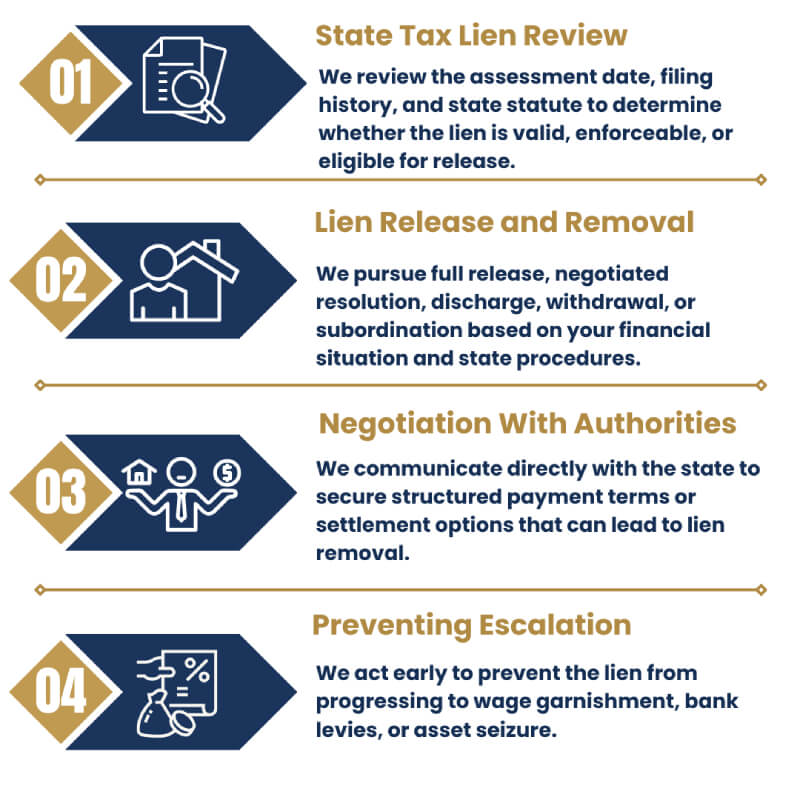
At J. David Tax Law, we represent taxpayers nationwide facing state tax liens, wage garnishments, and levy actions. Our approach is structured and strategic:
Conclusion
A state tax lien is a serious legal claim that can affect your property, credit, and financial flexibility until the underlying tax debt is resolved. While it does not immediately result in asset seizure, it signals that formal enforcement has begun and may escalate if left unaddressed. Because state lien laws and collection timelines vary, taking early action can preserve more resolution options and reduce the risk of garnishment or levy. If you are dealing with a state tax lien, J. David Tax Law can review your situation, evaluate available remedies, and develop a strategic plan to remove the lien and protect your assets.
Frequently Asked Questions
What is the purpose of a tax lien?
The purpose of a tax lien is to secure the government’s legal claim against your property when you fail to pay a tax debt. It ensures the state or IRS has priority over other creditors if your property is sold. A lien protects the government’s ability to collect what is owed.
Is a tax lien serious?
Yes, a tax lien is serious because it attaches to your property and can affect your ability to sell, refinance, or obtain credit. While it does not immediately seize assets, it signals that formal enforcement has begun. If unresolved, it may lead to garnishment or levy.
What happens if I ignore a tax lien?
If you ignore a tax lien, the government may escalate collection efforts. This can include wage garnishment, bank levies, or asset seizure. Ignoring the lien does not make it disappear and often limits your resolution options.
What is a notice of state tax lien?
A notice of state tax lien is a public document filed by a state tax agency to formally record its legal claim against your property. It alerts creditors that the state has priority rights to your assets due to unpaid taxes. Once recorded, it can affect property transactions and financing.