



Last updated on November 16th, 2025 at 06:21 pm
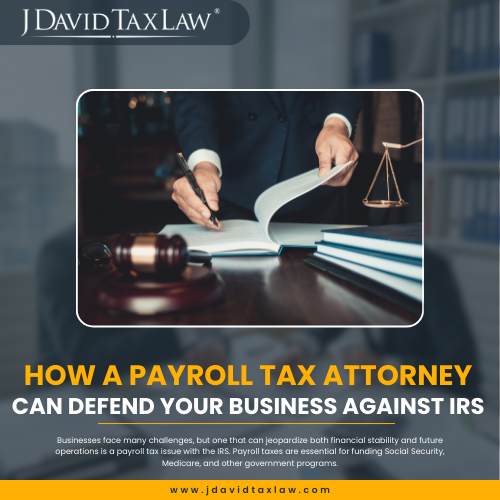
HOW A PAYROLL TAX ATTORNEY CAN DEFEND YOUR BUSINESS
Businesses face many challenges, but one that can jeopardize both financial stability and future operations is a payroll tax issue with the IRS. Payroll taxes are essential for funding Social Security, Medicare, and other government programs. However, failure to comply with payroll tax obligations can lead to significant legal and financial consequences, including IRS actions. If you’re dealing with payroll tax problems, a payroll tax attorney can be your strongest ally.
At J. David Tax Law, our team of payroll tax lawyers specializes in defending businesses from IRS payroll tax actions. Understanding the complexities of payroll tax law and providing tailored legal strategies to resolve disputes with the IRS can save your business from severe penalties or worse.
WHAT ARE PAYROLL TAXES?
Payroll taxes are deducted from an employee’s wages by the employer and remitted to the IRS to fund government programs such as Social Security and Medicare. Employers also pay a portion of Social Security, Medicare, and sometimes unemployment tax. For many small business owners, understanding the difference between income tax vs payroll tax can be confusing. Employers are responsible for collecting and remitting payroll taxes correctly. Failure to do so can trigger penalties and legal issues with the IRS.
COMMON IRS PAYROLL TAX ACTIONS
The IRS is serious when it comes to payroll tax enforcement. If your business fails to comply with payroll tax laws, you may face several types of IRS actions, including audits, liens, or levies. Below are some common payroll tax-related IRS actions:
- Payroll Tax Audits: The IRS examines whether payroll taxes were calculated and paid correctly.
- Payroll Tax Liens: If taxes are unpaid, the IRS may file a tax lien on business assets.
- Payroll Tax Penalties: Late or inaccurate payments can trigger significant fines.
HOW A PAYROLL TAX ATTORNEY CAN DEFEND YOUR BUSINESS
A payroll tax lawyer provides strategic protection against IRS actions. Here’s how:
- IRS Representation: Responding to IRS notices, handling audits, and negotiating disputes involving 941 payroll tax.
- Penalty Negotiation and Relief: Requesting penalty reductions or elimination based on reasonable cause.
- Lien Defense: Negotiating payment plans or an Offer in Compromise to remove liens.
- Payroll Tax Deposit Schedule Compliance: Ensuring correct deposit schedules to avoid future penalties.
PENALTIES AND CONSEQUENCES OF PAYROLL TAX NON-COMPLIANCE
Non-compliance can result in:
- Payroll Tax Penalties up to 15% of unpaid tax.
- Criminal Charges in cases of willful non-payment. More info: IRS Criminal Investigations.
- Deposit Schedule Penalties that escalate over time.
- Asset Seizure including bank accounts and property. More info: asset seizure.
STEPS TO PREVENT FUTURE PAYROLL TAX ISSUES
We help businesses avoid recurring payroll tax problems through:
- Payroll Tax Planning to ensure timely and accurate deposits.
- Compliance Reviews to detect issues early.
- Legal Guidance on evolving employment tax laws.
CONCLUSION
Payroll tax issues are serious and require immediate action. Working with an experienced payroll tax attorney ensures your business is protected and positioned to resolve disputes effectively. Contact J. David Tax Law today to discuss your options and safeguard your business.
Your Tax Relief Questions, Answered
A payroll tax attorney specializes in handling disputes with the IRS related to payroll taxes. They represent businesses in audits, negotiate penalties, help resolve tax liens, and create legal strategies to manage employment tax liability and resolve issues such as late or unpaid payroll taxes.
Yes, in extreme cases, failure to pay payroll taxes can result in criminal charges, including jail time. This usually happens if the IRS determines that the failure to pay is willful, meaning you intentionally didn’t remit the taxes. Our payroll tax attorneys are equipped to help businesses manage these serious situations. Contact us today to resolve your IRS disputes.
Payroll taxes are controlled by the IRS at the federal level and by state revenue departments at the state level, with employers responsible for withholding and submitting the taxes. IRS Overview of Payroll Taxes
Income tax is based on an individual’s earnings and paid directly by the employee. Payroll tax, on the other hand, is collected from employees’ wages by employers, who then remit the amount to the IRS. Payroll taxes are specifically used to fund Social Security, Medicare, and other government programs.
You can avoid payroll tax penalties by staying compliant with the IRS’s payroll tax deposit schedules, filing forms like the 941 on time, and accurately calculating payroll taxes. Consulting a payroll tax attorney for planning and compliance reviews is one of the best ways to ensure your business avoids penalties.